
Patients open up more when no one is watching
Greater than three in four patients found Doccy's voice AI agent easy to talk to, and nearly half felt more comfortable sharing sensitive information with it than with a person.
Clinical intake, the first conversation between a patient and their healthcare provider, involves sharing a large amount of personal and health information. It can be repetitive and time consuming for patients, and it adds to a growing administrative load for clinicians. Doctors spend an increasing share of their time on administration rather than clinical care [1-3], and this burden is linked to burnout [4].
Conversational AI agents are computer programs that hold a natural conversation with a person through text or speech [5]. Powered by large language models, they can gather information, ask follow-up questions about symptoms and respond in context. In healthcare they are already used for history taking, triage, self-management support and mental health assessment [6-9]. Their suggested benefits include less administration, smoother interactions between patients and clinicians, and wider access to care [10-13].
A voice AI agent takes this a step further. Patients simply talk, as they would to a clinician, without the typing and reading that text-based chatbots require. Early studies, such as automated follow-up calls after cataract surgery in the UK, show good patient acceptance [14]. However, most evidence still comes from simulations and small pilots, and little is known about how patients experience these tools in real-world care [11].
This summary draws on 23,875 real patient responses collected after a live Doccy consultation, making it one of the largest real-world analyses of how patients experience a voice AI agent in telehealth.
At a glance…
| 78% | found the voice AI agent easy to talk to |
| 72% | would use the voice AI agent again |
| 69% | felt it understood them well |
| 66% | found it easier than filling in a form |
| 49% | were more comfortable sharing sensitive information with the voice AI agent than with a person |
| ~2 in 5 | stayed neutral on AI, the largest single group on every attitude question |
About this evaluation
This evaluation draws on an optional, eight-question survey completed at the end of a Doccy consultation between June and September 2026. In each consultation a voice AI agent leads the intake conversation, and an AHPRA-registered doctor reviews the information before any care decision.
- Who completed the survey: 23,875 respondents, slightly more individuals identified as female compared to male, with around two in three aged 18-34 years.
- What we asked: four usability questions (combined into a usability score out of 5), plus questions on sharing sensitive information, preference of the voice AI agent* versus a doctor, and comfort with AI in everyday life.
- How to read the numbers: all figures are percentages of everyone who completed the survey, unless stated otherwise. Postal area data, and the population density, remoteness and socioeconomic data linked to it, were available for just under half of respondents (46%), so these figures are percentages of those 10,881.
*referred to as the “AI call” for simplicity within the survey
Key Insights
A positive, highly usable experience
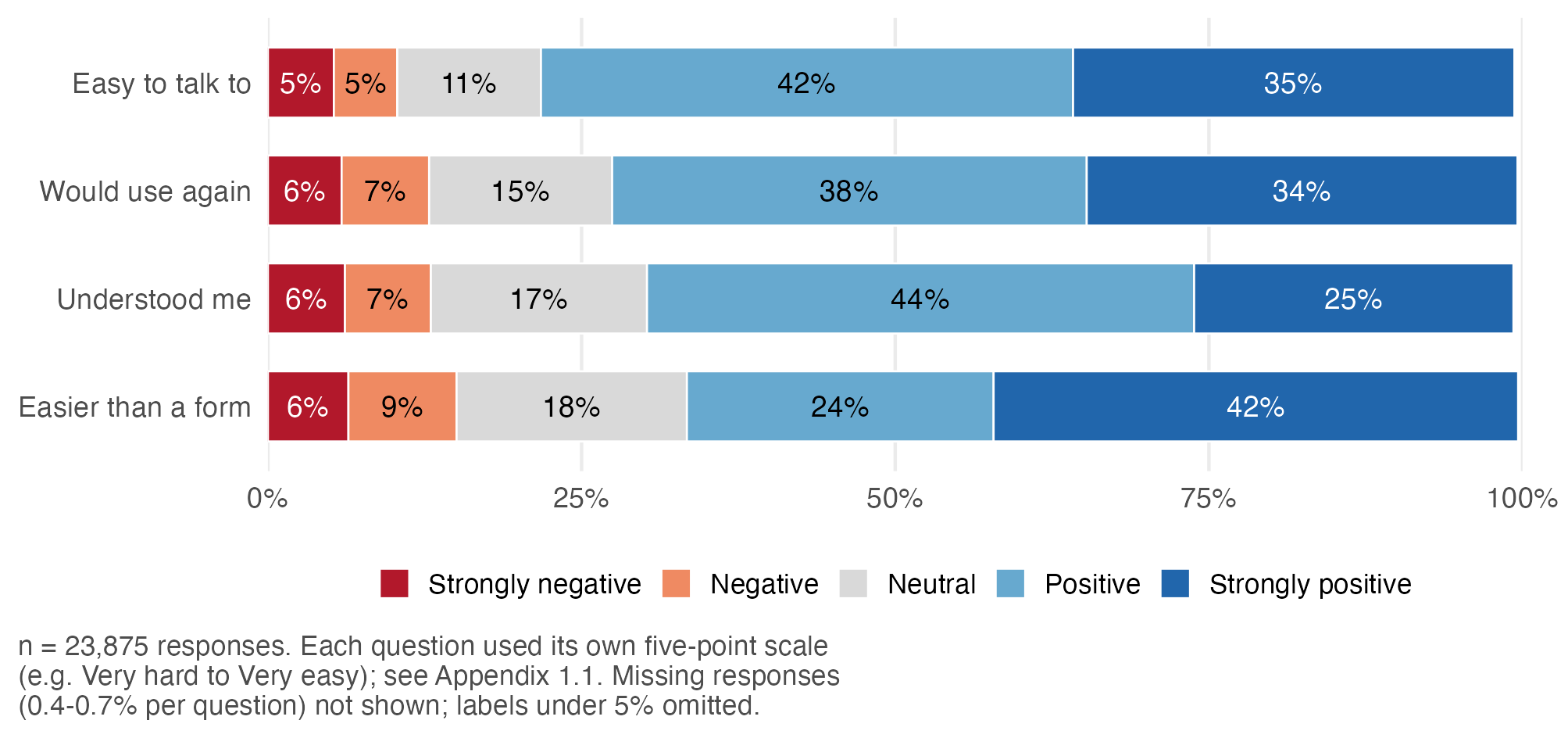
Patients rated the voice AI agent highly on every usability measure. Positive responses were received for 66-78% across all usability questions, with only 10-15% responding negatively. The average Usability Score was 3.88 out of 5. Female and males rated the experience almost identically (average usability score 3.90 vs 3.88 out of 5).
Looking at the strongest answers: 42% found it much easier than filling in a form, 35% found the agent very easy to talk to, and 34% would definitely use it again.
Older age groups rated the experience highest
Usability Scores rose steadily with age, from 3.76 out of 5 among 18-24 year olds to 4.18 among those aged 65 and over. This compares with an average of 3.88 across all respondents.
The difference is statistically significant but small: age explains about 1% of the variation in scores. Earlier research found younger people were generally more willing to use AI in healthcare [15]. Among patients who had actually used the voice AI agent, it was older adults who rated the experience most highly.
We did not measure why, but there are several possible explanations. Speaking rather than typing may remove the reading and dexterity demands of text-based tools. Older adults who choose an AI-enabled service may be a self-selected group with different expectations. And younger people, who use AI tools more often, may simply have higher expectations of usability.
AI-led intake can feel like a safe space for sensitive topics
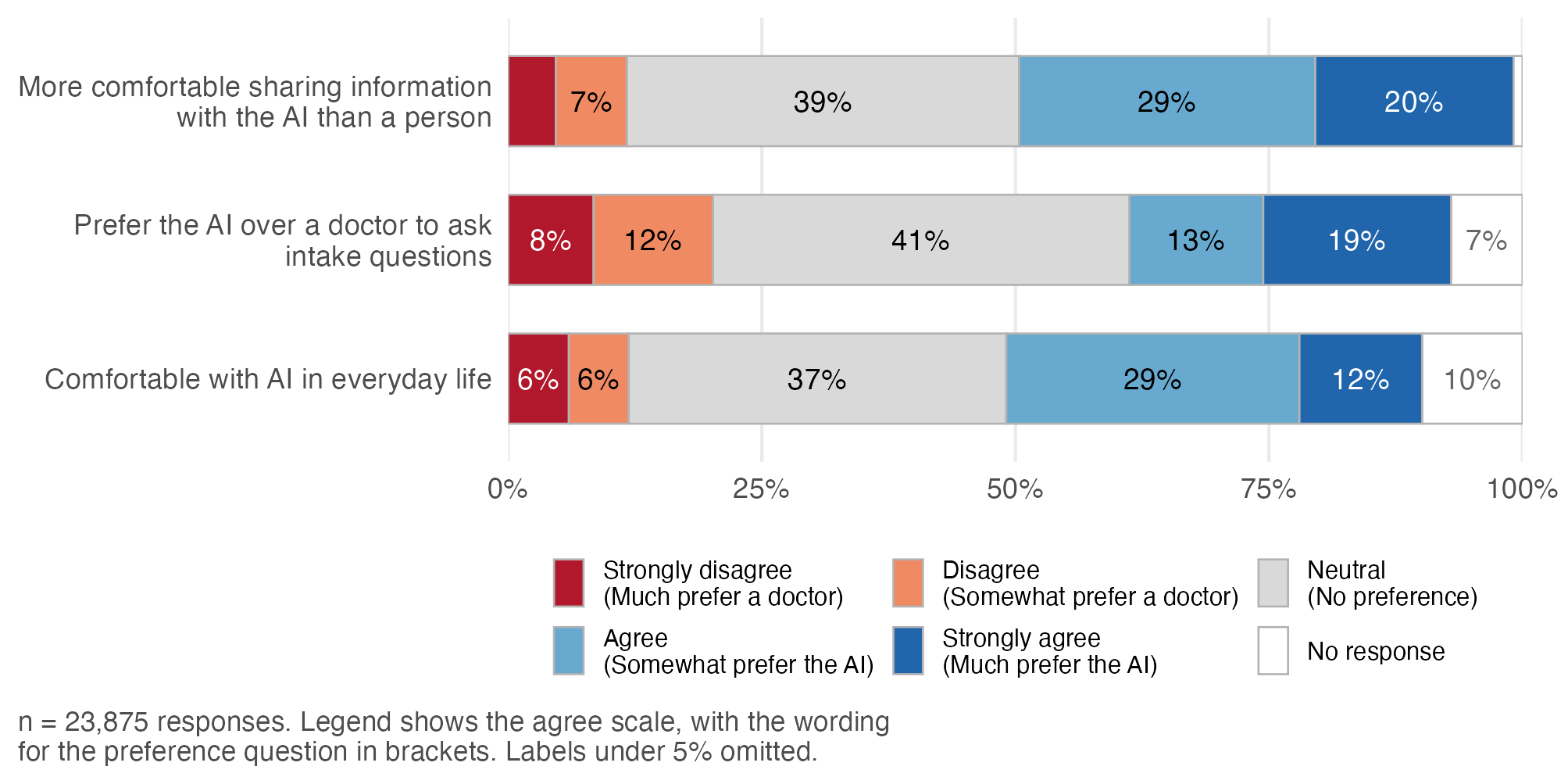
49% of respondents felt more comfortable discussing sensitive information with the voice AI agent than a person, against 12% who did not. Of the 7,129 respondents who told us why they preferred the AI, the top three reasons were close to evenly split:
| Reason | Share who chose it |
|---|---|
| No judgement | 49% |
| Less awkward | 49% |
| More private | 48% |
| Could take my time | 30% |
Respondents could choose more than one reason.
Open to AI, but not yet decided
The largest group on every attitude question was neutral. On the voice AI agent versus a doctor, 41% had no preference, 32% preferred the AI and 20% preferred a doctor. On AI in everyday life, 41% were comfortable, 37% were neutral and 12% were not.
Most respondents were trying the service for the first time. A large neutral group is typical of a new technology in early adoption, when opinions are still forming.
Reaching patients across Australia
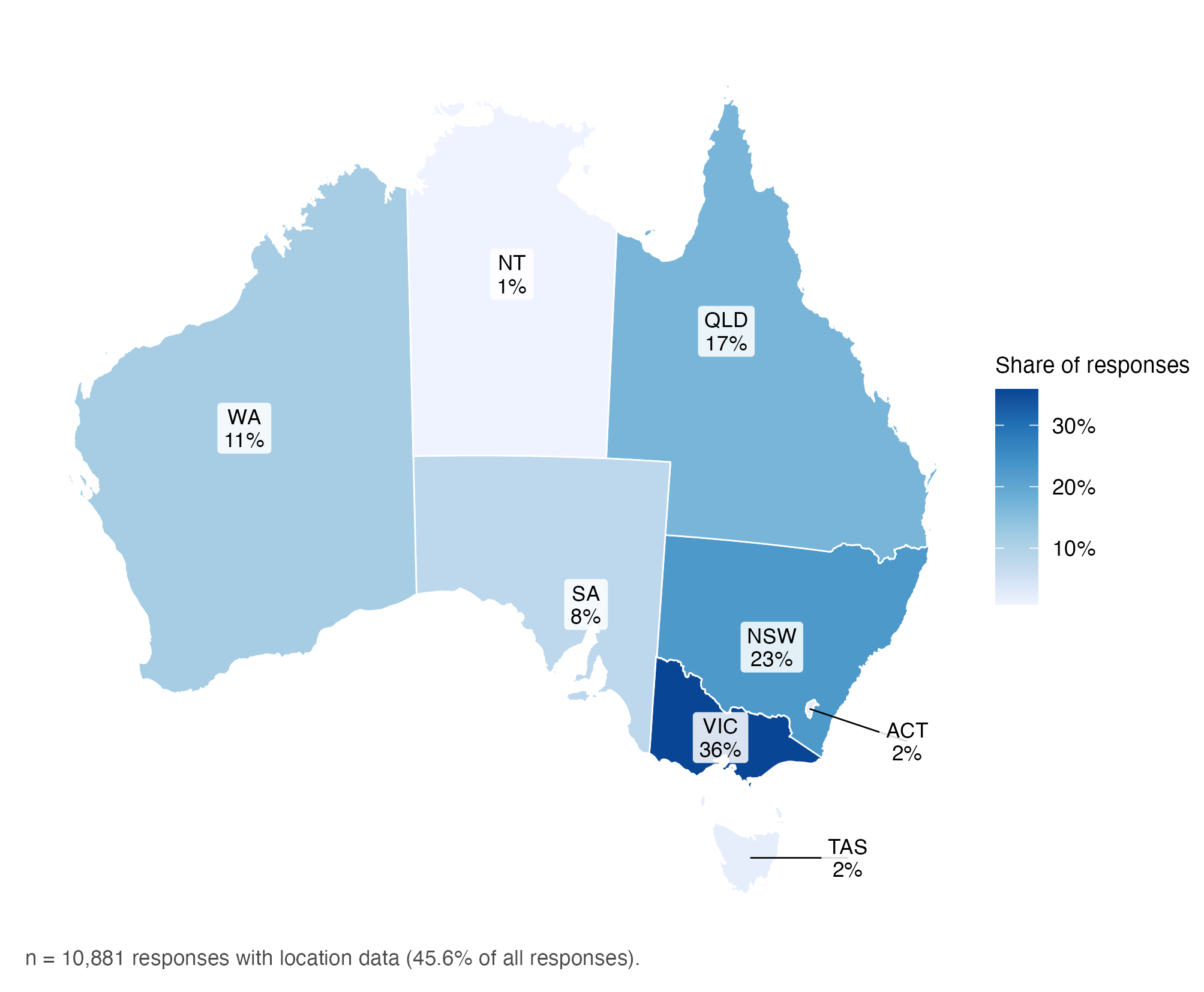
Doccy patients come from every state and territory in Australia. Among respondents with postal area data, majority of patients come from our home state of Victoria (36%) followed by New South Wales (23%), with about 1% living in the Northern Territory.
- Population density: respondents came from postal areas ranging from sparsely populated (fewer than 50 residents per km², 10%) to densely populated (5,000 or more per km², 6%). Half of the cohort (51%) with postal area data lived in postal areas with 1,000-4,999 residents per km² [18].
- Remoteness: around one in seven (14%) live outside major cities: 9% in inner regional areas and 5% in outer regional, remote or very remote Australia [16].
- Across socioeconomic groups: one in three (34%) live in areas ranked as the two most disadvantaged quintiles of the ABS Index of Relative Socio-economic Disadvantage [17].
Figures are percentages of respondents with postal area data (46% of responses). Remoteness was available for 37% of responses.
 ---
Important considerations
- Easy to use, but no clear verdict. Patients rate the experience well but stay neutral on AI in general. A good experience has not yet turned into a firm preference.
- Patients preferred the voice AI agent, with a doctor still in the loop. Far more preferred the AI call than a doctor (32% vs 20%). Each consultation still ends with a doctor’s review, which may be why outright opposition is rare.
- The youngest adults are the toughest critics. 18-24 year olds gave the lowest usability scores. One possible explanation is that younger people use AI tools more often and expect more from them, although we didn't measure this.
- Our reach is broad, including regional and remote patients. Around one in seven respondents with remoteness data (14%) live outside a major city, where in-person care can be harder to reach. Voice intake may help close that access gap.
What this means
- Lead with sensitive care. Comfort in sharing sensitive information makes the voice AI agent a strong fit for sexual health, mental health and other stigmatised areas.
- Keep the doctor visible. Patients appear comfortable with AI-supported intake when a doctor clearly stays responsible for their care.
- Win over the undecided. Two in five patients are neutral. Repeat use, clear explanations of what the voice AI agent does, and reliable understanding are likely to help.
- Design for all ages. Voice appears to work well for older adults, who are often assumed to resist digital tools.
- Look beyond age. Age explains little of the variation in usability. Patient factors (such as health status and health literacy) and voice AI agent factors (such as speech recognition and conversation flow) were beyond the scope of this evaluation but are likely to matter more, and should be explored next.
Limitations
The survey was optional and offered at the end of a consultation, so more engaged or satisfied patients may be over-represented. Patients who found the experience frustrating may have been more likely to stop before reaching the survey, which could inflate positive results. The questions were developed internally for quality improvement and are not a validated instrument; positive wording may have influenced answers, and response scales varied between questions. There was limited demographic information and no data on health status, health outcomes or health literacy.
Future research should explore how familiarity with technology outside healthcare shapes patients' experience of the voice AI agent alongside more detailed health literacy assessment.
Methods & Analysis
Data: Responses came from an optional feedback survey shown at the end of each Doccy consultation between June and September 2026, for the purpose of quality improvement. Answers were linked to age group, gender and postal area. Postal areas were matched to Australian Bureau of Statistics (ABS) 2021 Census data on population density, remoteness and socioeconomic disadvantage [16-18]. All identifying information, including postal areas, was removed before analysis.
Survey: Seven questions used five-point Likert scales. Four questions covered usability of the voice AI agent and three related to disclosure of information, preference and attitude towards using AI. An additional follow-up question asked those who were comfortable sharing sensitive information with the voice AI agent to select pre-defined reasons why. Surveys with at least five out of the seven core questions answered were treated as complete; incomplete surveys were excluded.
Usability Score: Four questions (understanding, ease of talking, willingness to use again, and ease compared to a form) were each scored 1 to 5 and averaged. The score showed excellent internal consistency (Cronbach’s α = 0.91). It was calculated only where all four usability questions were answered.
Analysis: Responses were summarised as percentages of all complete surveys; population density, remoteness and socioeconomic figures are percentages of responses with postal area data. Differences in Usability Score across adult age groups were tested with Welch's ANOVA and Games-Howell post-hoc comparisons (F(5, 1,144.7) = 47.99, p < .001; η² = 0.010). Under-18s were excluded from the age analysis because a parent or carer completed their survey. Analyses were run in R (version 4.6.1).
Appendix 1.1 Survey Questions
| Questions | Responses | |
|---|---|---|
| Q1. | How well did it understand you? | Not at all |
| Q2. | How easy was it to talk to? | Very hard |
| Q3. | Would you use the AI call again? | Definitely not |
| Q4. | Easier or harder than filling in a form? | Much harder |
| Q5. | I’m more comfortable discussing sensitive information here than with a person. | Strongly disagree |
| Q6. | If Strongly Agree/Agree, why is this the case? (can select more than one) | More private |
| Q7. | Prefer the AI call or seeing a doctor? | Much prefer the AI |
| Q8. | In general, I’m comfortable using AI in everyday life. | Strongly disagree |
- Sinsky CA, et al. Allocation of physician time in ambulatory practice: a time and motion study in four specialties. Ann Intern Med. 2016;165(11):753-60. doi:10.7326/M16-0961
- Arndt BG, et al. Tethered to the EHR: primary care physician workload assessment using EHR event log data and time-motion observations. Ann Fam Med. 2017;15(5):419-26. doi:10.1370/afm.2121
- Brown A, Enticott J, Russell G. How do Australian general practitioners spend their time? Aust J Gen Pract. 2021;50(9):661-6. doi:10.31128/AJGP-09-20-5631
- Shanafelt TD, et al. Relationship between clerical burden and characteristics of the electronic environment with physician burnout and professional satisfaction. Mayo Clin Proc. 2016;91(7):836-48. doi:10.1016/j.mayocp.2016.05.007
- Tudor Car L, et al. Conversational agents in health care: scoping review and conceptual analysis. J Med Internet Res. 2020;22(8):e17158. doi:10.2196/17158
- Hong G, Smith M, Lin S. The AI will see you now: feasibility and acceptability of a conversational AI medical interviewing system. JMIR Form Res. 2022;6(6):e37028. doi:10.2196/37028
- Colakca C, et al. Emergency department triaging using ChatGPT based on emergency severity index principles. Sci Rep. 2024;14(1):22106. doi:10.1038/s41598-024-73229-7
- Trivedi R, et al. Patient perspectives on conversational artificial intelligence for atrial fibrillation self-management. J Med Internet Res. 2025;27(1):e64325. doi:10.2196/64325
- Comulada SW, et al. Development, feasibility, acceptability, and usability of an AI-powered chatbot (Suzy) to support patients in substance use disorder recovery. JMIR Form Res. 2026;10:e84683. doi:10.2196/84683
- Milne-Ives M, et al. The effectiveness of artificial intelligence conversational agents in health care: systematic review. J Med Internet Res. 2020;22(10):e20346. doi:10.2196/20346
- Hindelang M, Sitaru S, Zink A. Transforming health care through chatbots for medical history-taking and future directions: comprehensive systematic review. JMIR Med Inform. 2024;12:e56628. doi:10.2196/56628
- Laranjo L, et al. Conversational agents in healthcare: a systematic review. J Am Med Inform Assoc. 2018;25(9):1248-58. doi:10.1093/jamia/ocy072
- Farina JM, et al. Conversational AI for clinical intake: a feasibility and acceptability pilot study. Mayo Clin Proc Digit Health. 2026;100391. doi:10.1016/j.mcpdig.2026.100391
- Meinert E, et al. Accuracy and safety of an autonomous artificial intelligence clinical assistant conducting telemedicine follow-up assessment for cataract surgery. eClinicalMedicine. 2024;73. doi:10.1016/j.eclinm.2024.102692
- Young AT, Amara D, Bhattacharya A, Wei ML. Patient and general public attitudes towards clinical artificial intelligence: a mixed methods systematic review. Lancet Digit Health. 2021;3(9):e599-611. doi:10.1016/S2589-7500(21)00132-1
- Australian Bureau of Statistics. Remoteness Areas. Australian Statistical Geography Standard (ASGS) Edition 3, July 2021 - June 2026. Canberra: ABS; 2023. abs.gov.au
- Australian Bureau of Statistics. Socio-Economic Indexes for Areas (SEIFA), Australia, 2021. Canberra: ABS; 2023. abs.gov.au
- Australian Bureau of Statistics. Census of Population and Housing, 2021: Census DataPacks (Postal Areas). Canberra: ABS; 2022. abs.gov.au